Learn 20 essential German sentence patterns with simple examples and English translations. A beginner-friendly guide to help you build sentences, speak confidently, and understand German faster.
Most beginners try to learn German by memorizing words and grammar rules. But words alone don’t help you speak – sentence patterns do.
German (like every language) is built from repeatable structures. Once you know these patterns, you can build hundreds of sentences even with limited vocabulary.
This guide shows you 20 simple German sentence patterns, each with:
- A clear structure
- A simple example
- An English translation
- An explanation that actually makes sense
Learn these patterns, and German becomes predictable – even easy.
⭐ Why Sentence Patterns Matter More Than Grammar Tables
This is how your brain learns a language:
- not by memorizing rules
- not by translating word by word
- not by analyzing every detail
but by recognizing patterns.
German becomes much simpler when you learn:
- the order of information
- how verbs behave
- where the important parts go
Once a pattern becomes familiar, your brain can use it automatically.
Let’s start.
1. Ich bin … (I am …)
The simplest pattern in German.
Ich bin müde. – I am tired.
Ich bin glücklich. – I am happy.
Use it for descriptions of yourself.
2. Ich habe … (I have …)
Perfect for everyday needs.
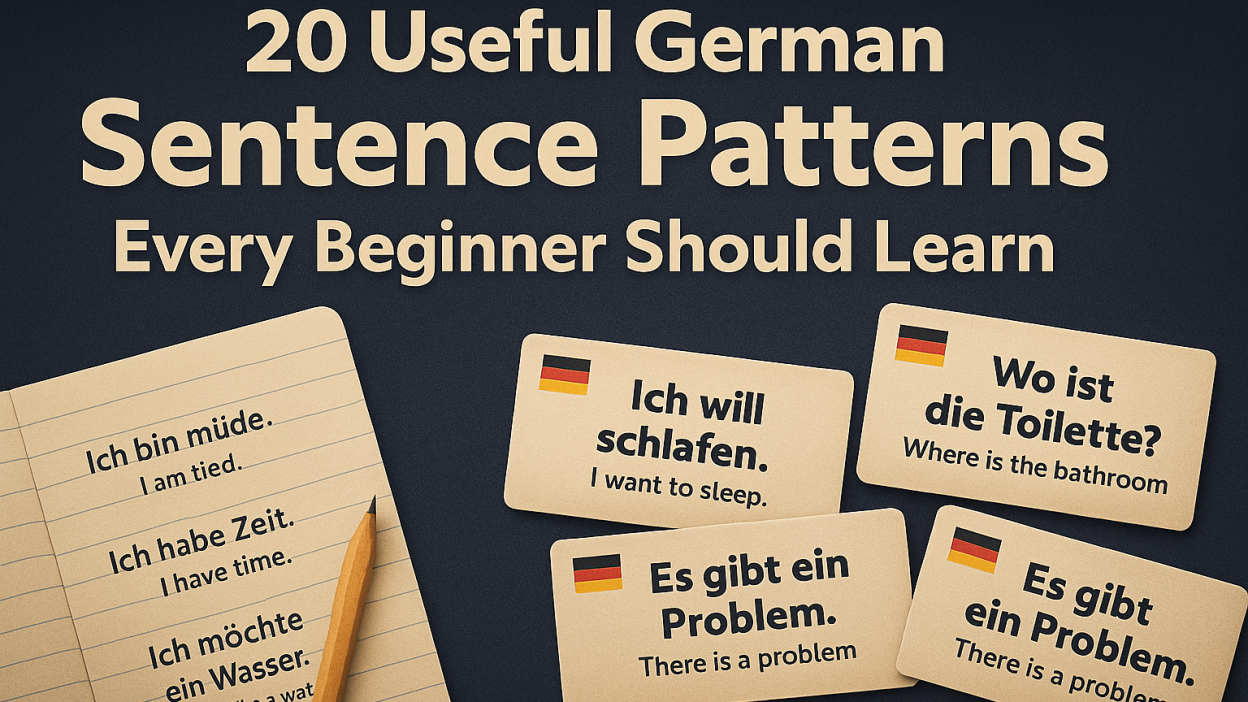
Ich habe Zeit. – I have time.
Ich habe Hunger. – I am hungry.
Note: Ich habe Hunger means “I have hunger,” but it’s used like “I am hungry.”
3. Ich möchte … (I would like …)
Polite way to ask for things.
Ich möchte ein Wasser. – I would like a water.
Ich möchte bezahlen. – I would like to pay.
Use this in restaurants, cafés, shops.
4. Ich brauche … (I need …)
Very useful for daily communication.
Ich brauche Hilfe. – I need help.
Ich brauche einen Termin. – I need an appointment.
5. Ich gehe … (I am going …)
For movement or plans.
Ich gehe zur Arbeit. – I’m going to work.
Ich gehe nach Hause. – I’m going home.
6. Ich will … (I want …)
Stronger than möchte.
Ich will schlafen. – I want to sleep.
Ich will lernen. – I want to study.
7. Ich kann … (I can …)
For abilities or possibilities.
Ich kann Deutsch sprechen. – I can speak German.
Ich kann heute nicht. – I can’t today.
8. Ich muss … (I must / have to …)
Expresses necessity.
Ich muss arbeiten. – I have to work.
Ich muss gehen. – I must go.
9. Ich mag … (I like …)
For preferences.
Ich mag Kaffee. – I like coffee.
Ich mag Musik. – I like music.
10. Es gibt … (There is / There are …)
One of the most useful patterns.
Es gibt ein Problem. – There is a problem.
Es gibt viele Möglichkeiten. – There are many possibilities.
11. Das ist … (That is …)
For identifying and describing things.
Das ist gut. – That is good.
Das ist mein Freund. – That is my friend.
12. Wie heißt …? (What is the name of …?)
Perfect for introductions.
Wie heißt du? – What is your name?
Wie heißt das? – What is this called?
13. Wo ist …? (Where is …?)
Your essential navigation phrase.
Wo ist die Toilette? – Where is the bathroom?
Wo ist der Bahnhof? – Where is the train station?
14. Wie viel …? (How much …?)
Used everywhere when paying or shopping.
Wie viel kostet das? – How much does this cost?
Wie viel Zeit haben wir? – How much time do we have?
15. Ich denke, dass … (I think that …)
Introduces opinions.
Ich denke, dass es gut ist. – I think that it is good.
Ich denke, dass er kommt. – I think that he is coming.
(Note: The verb goes to the end in “dass”-sentences.)
16. Ich glaube, dass … (I believe that …)
Similar to “I think,” more about belief.
Ich glaube, dass sie Recht hat. – I believe she is right.
Ich glaube, dass es regnet. – I believe it is raining.
17. Ich weiß nicht, ob … (I don’t know if …)
Great for uncertainty.
Ich weiß nicht, ob er kommt. – I don’t know if he is coming.
Ich weiß nicht, ob das stimmt. – I don’t know if that’s true.
18. Kannst du … ? (Can you … ?)
Friendly request.
Kannst du mir helfen? – Can you help me?
Kannst du das erklären? – Can you explain that?
19. Darf ich … ? (Am I allowed to … ?)
For polite permission.
Darf ich hier sitzen? – May I sit here?
Darf ich fragen? – May I ask?
20. Ich freue mich auf … (I’m looking forward to …)
A beautiful, positive sentence pattern.
Ich freue mich auf das Wochenende. – I’m looking forward to the weekend.
Ich freue mich auf deinen Besuch. – I’m looking forward to your visit.
⭐ How to Practice These Sentence Patterns Effectively
To make these patterns automatic:
- Repeat each one out loud
- Write 1–2 sentences using each pattern
- Listen for them in podcasts and videos
- Reuse them daily in small conversations
- Don’t aim for perfection – aim for use
Patterns are the shortcut to speaking.
⭐ Keep Going: Build Your German Naturally
These sentence patterns work even better when combined with:
👉 Top 100 Most Common German Verbs
👉 Top 50 German Adjectives (With Examples)
👉 A Simple Daily Routine to Learn German Faster
Small steps. Simple explanations. Daily progress.
That’s how German becomes yours.